Juno Microwave Radiometer Observations Reveal A Warmer Polar Atmosphere on Jupiter
AI Based on high-resolution microwave observations from NASA’s Juno spacecraft, this study reveals that Jupiter’s north pole is approximately 6–7 K warmer than its equator at the 1-bar level, suggesting an enhanced internal heat flux toward the poles that may sustain the planet’s unique circumpolar cyclone pattern.
Jiheng Hu, Cheng Li*, with the Juno MWR Team
The Astrophysical Journal 2026
The intriguing circumpolar cyclone pattern at Jupiter’s poles raises fundamental questions about how these systems are organized vertically and, further, how the planet’s internal heat shapes and sustains them in the absence of solar insolation.
We report recent close-in observations of Jupiter’s north pole acquired by NASA’s Juno Microwave Radiometer (MWR), which achieved comprehensive microwave mapping of the region at an unprecedentedly high resolution.
Using six-channel measurements from eleven perijove passes (PJ51–PJ61) poleward of $75^\circ$N, we derive polar-mean nadir brightness temperatures and limb-darkening spectra that together point to two equally plausible atmospheric scenarios: (1) a dry-adiabatic profile with slightly depleted ammonia gas at a few bars, or (2) a moist-adiabatic profile with uniform ammonia.
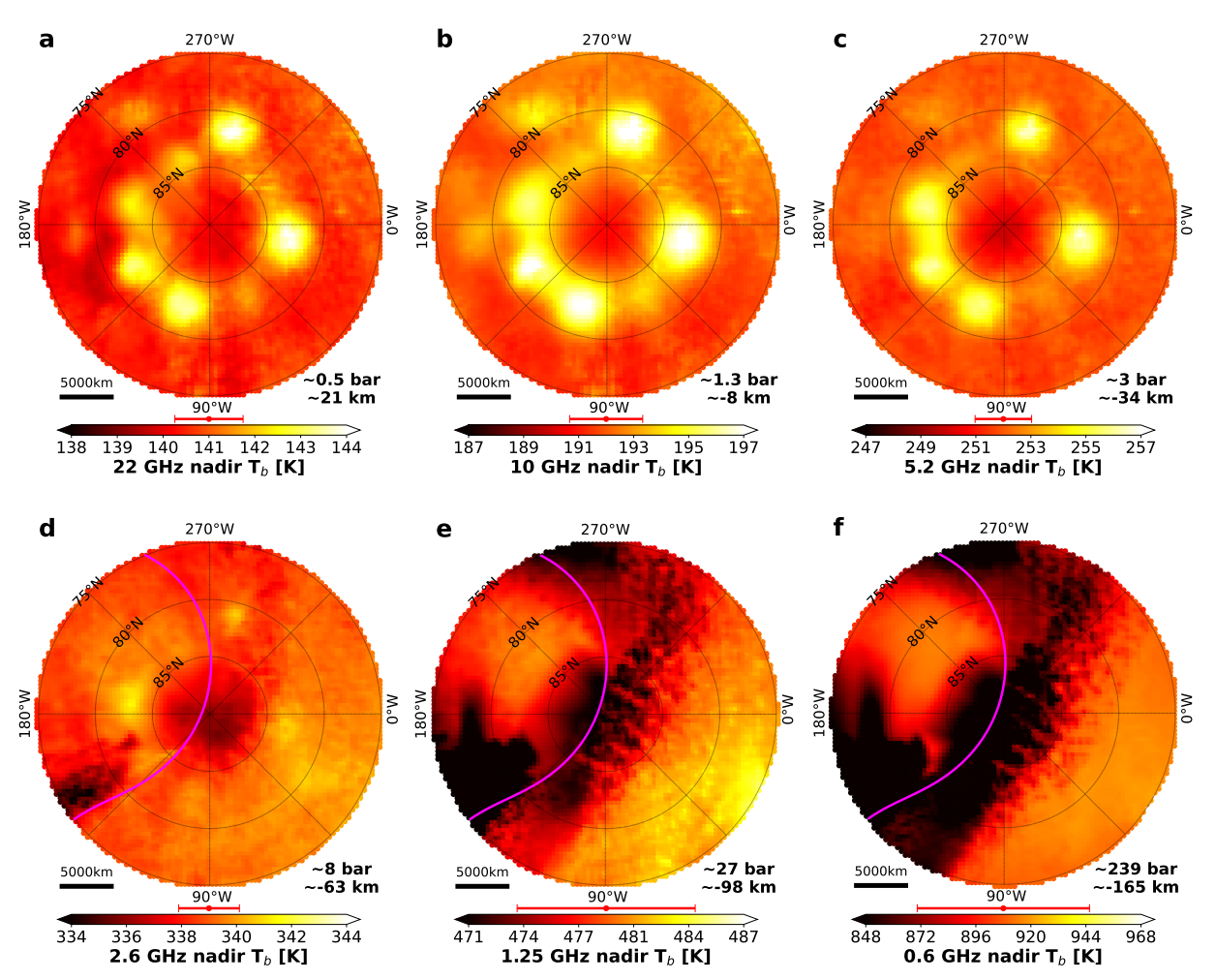 MWR's Six-band spectra over Jupiter's north pole
The Jovian north pole is characterized by a polygonal arrangement of eight circumpolar cyclones (CPCs), which manifest as notable brightness anomalies in microwave frequencies against the polar background. Five of these CPCs appear significantly brighter than the remaining three, being clearly distinguishable from the polar background even at a depth of approximately 8 bar . At the center of the domain lies the north polar cyclone (NPC), which appears as a region of significantly negative brightness temperature anomaly (down to -3 K) relative to the background, suggesting a distinct origin from the surrounding CPCs.
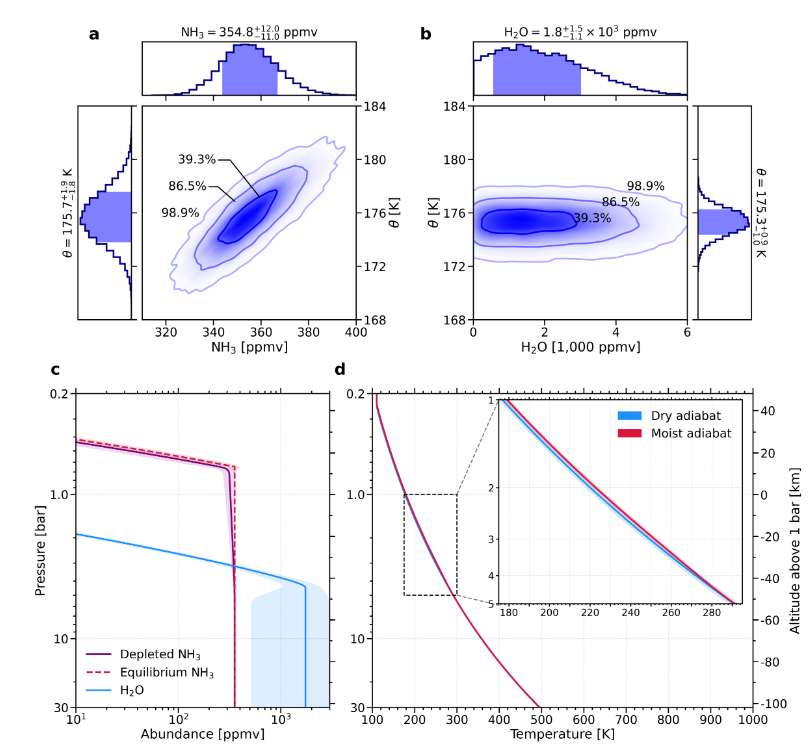
Bayesian inversion of deep parameters in Jupiter north pole
Markov chain Monte Carlo retrievals yield a deep ammonia abundance of 354.8+12.0/-11.0 ppmv (~3 +/- 0.1 x solar), and a water abundance of 1800+1500/-1100 ppmv (~2.1+1.8/-1.3 x solar), resembling previous estimates at lower latitudes.
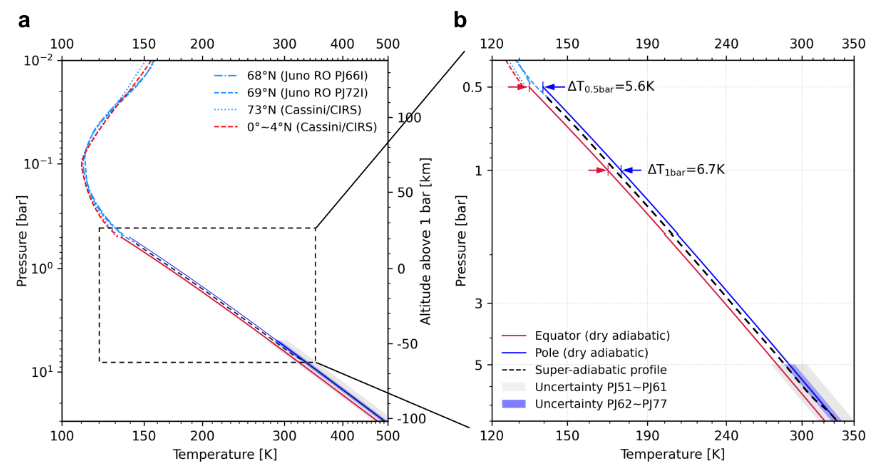
Comparison of atmospheric thermal structure across Jupiter
Remarkably, the north pole is found to be 6–7 K warmer than the equator at the 1-bar level, although the inferred difference is close to the 1-sigma uncertainty level. If confirmed, this result would suggest an enhanced internal heat flux toward the poles, which is consistent with the more intense lightning activity observed at high latitudes.