Research
Planetary science
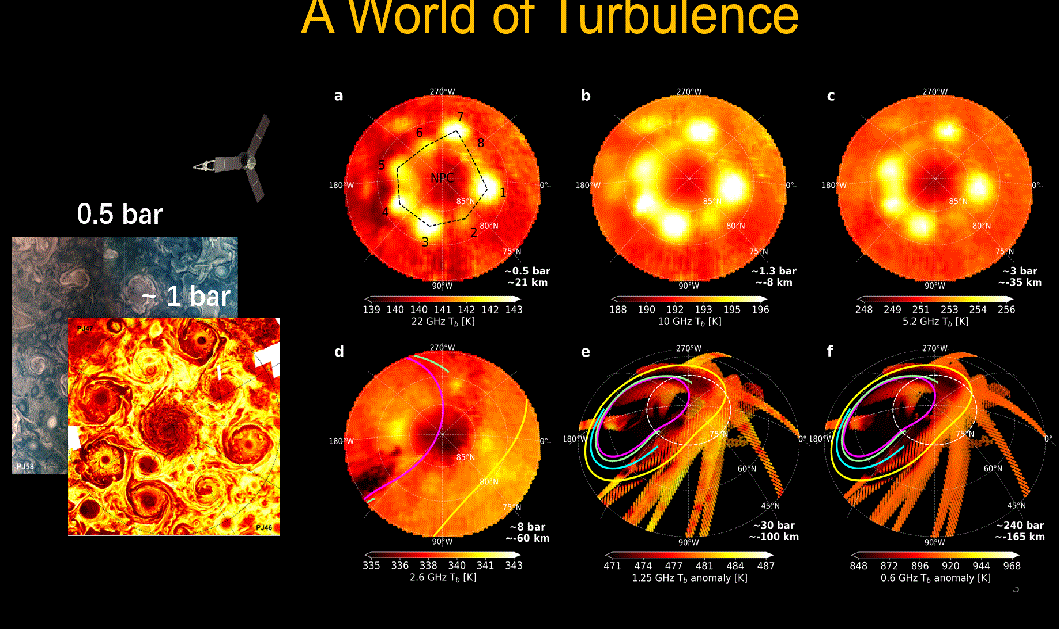
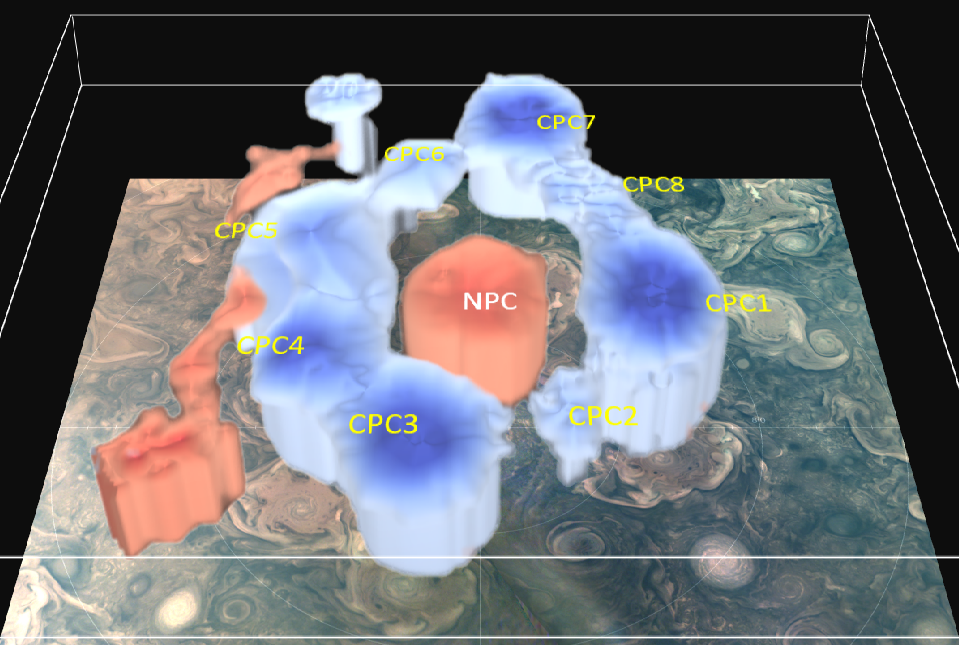
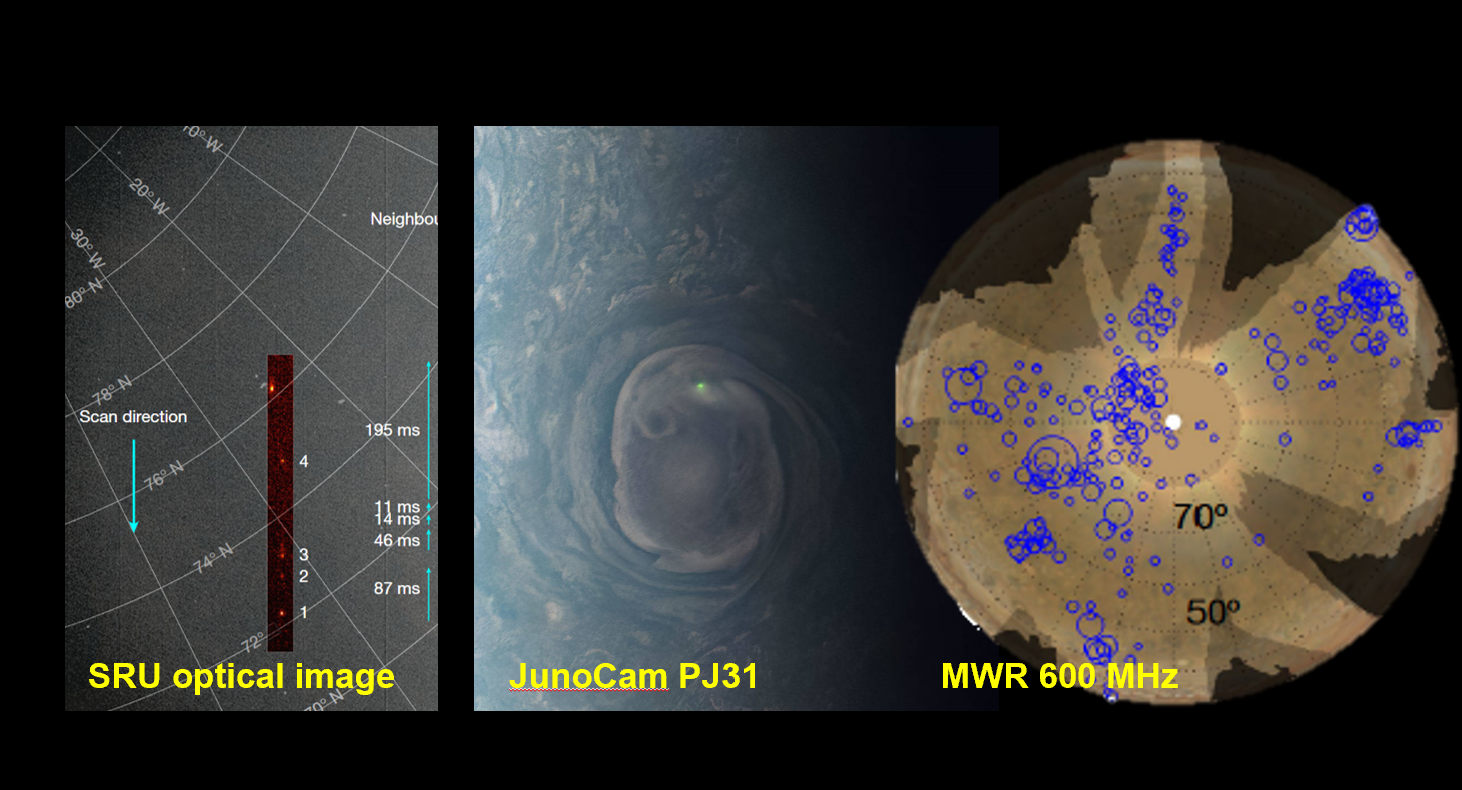
Jupiter’s polar regions host persistent circumpolar cyclones arranged in stable polygonal configurations around a central polar vortex. We examine the vertical structure and thermodynamic properties of these systems, which provide valuable insight into the mechanisms governing their genesis, evolution, and long-term stability in the context of prevailing jets, planetary waves, and vorticity gradients. Multi-frequency microwave observations from the Microwave Radiometer (MWR) probe ammonia distributions and temperature anomalies beneath the visible cloud layer. Physical atmospheric models incorporating alternative thermal structures and compositional gradients are constructed and tested against the observed spectra to assess whether these vortices are shallow weather-layer features or deeply rooted atmospheric disturbances extending to tens of bars.
Earth system
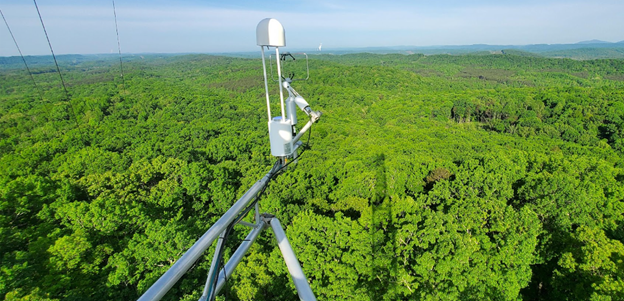
Microwave remote sensing provides a powerful framework for investigating terrestrial ecohydrological dynamics across diverse climate regimes. Passive microwave (PMW) observations, incoperating with physically based radiative transfer modeling, provide effective and instaneous approach quantifying soil moisture, vegetation water content, and land–atmosphere exchanging fluxes. We develop surface parameter inverison algorithms, key datasets, forward models and the relevant data assimilation techniques which incorporate satellite observations into land surface models. Together, these effects enable improved monitoring of soil moisture variability, vegetation dynamics, and water–energy interactions at regional to global scales.

Cometary science
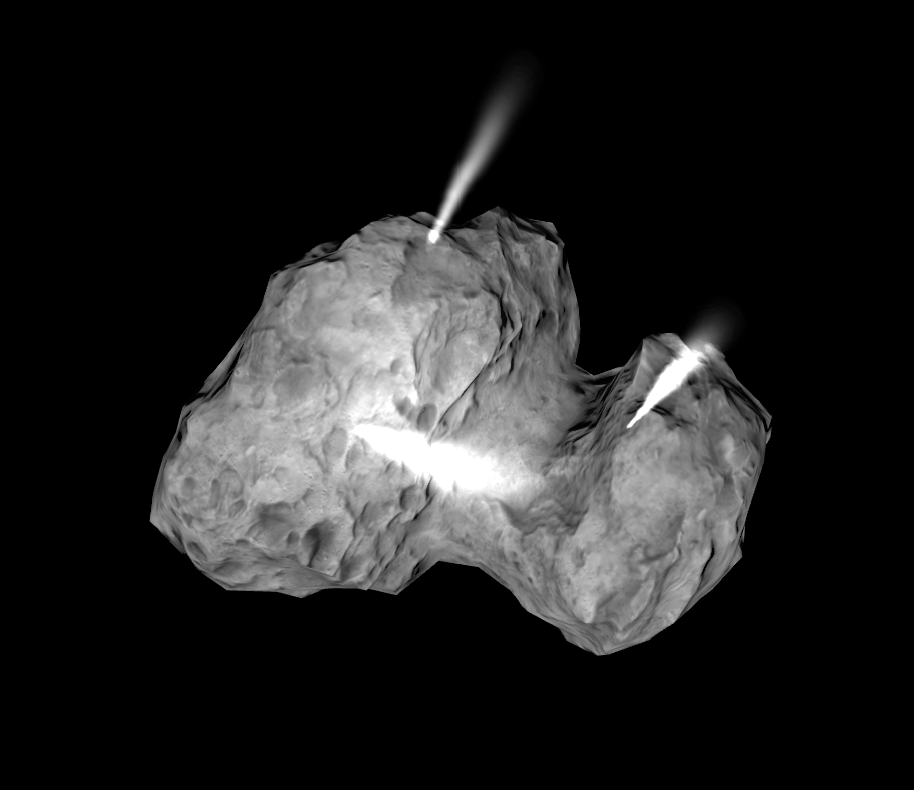
We investigate comae gas composition and nucleus outgassing activity through numerical radiative transfer model designed to interpret spectra from terrestrial telescopes and flyby missions. Physical models couple level excitations, collision induced absroptions, and Non-LTE radiative transfer to reproduce observed line intensities and continuum emission. By analyzing heliocentric-distance–dependent outgassing and compositional variability, this work constrains surface activity patterns and volatile inventories. The results link present-day coma abundances to protosolar nebula composition and illuminate the chemical and thermal processes that shaped current elemental and isotopic ratios.